
Korea Deep Learning to automate insurance claims with DEEP Agent
Korea Deep Learning enters the insurance market with DEEP Agent, an AI solution that automates document verification and claim processing.
[UP! START] Korea Deep Learning: Leave insurance claims to 'DEEP Agent'
| NBNTV = Jeong Dong-jin
Korea Deep Learning is entering the insurance market, poised to transform the landscape of insurance claims.
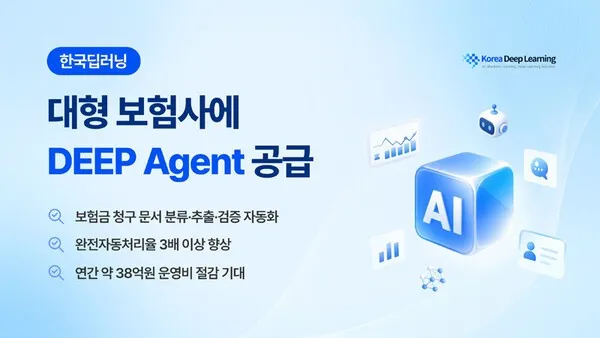
According to Korea Deep Learning on the 11th, the company will supply its document automation solution, DEEP Agent, to a major domestic insurer. The insurer decided to adopt DEEP Agent to automate not just simple document recognition, but also the organization of documents per claim, information extraction, result verification, and the selection of exception documents.
Previously, various supporting documents such as insurance claim forms, detailed medical expense statements, receipts, ID cards, and copies of bankbooks were first recognized using OCR. Then, for documents where the results were uncertain or items were missing, external inspection personnel had to manually cross-check them against the original documents. As claim volumes increased, dozens of additional external inspectors had to be deployed, incurring costs of approximately 2,500 to 3,000 KRW per document. Even after the introduction of AI, the structure remained such that labor and operating costs increased alongside document volume due to the need for re-inspection of complex tables, low-quality images, and varying formats.
DEEP Agent organizes multiple documents included in a single insurance claim into one unit of work. It groups received documents by claim to check if mandatory documents have been submitted, and normal cases where both documents and information are confirmed are passed to the subsequent review stage. Because missing documents, information mismatches, or low-confidence results requiring original document verification are separated as distinct exceptions, managers can focus only on claim cases that require supplementary requests or additional judgment.
While conducting this project, Korea Deep Learning advanced the core processing engine of DEEP Agent, expanding its processing scope beyond print-based structured documents to high-difficulty documents such as handwriting, complex tables, low-quality images, and medical expense details spanning multiple pages.
First, the OCR performance was enhanced to reliably recognize key information such as numbers and amounts even in receipts or medical documents where photos are tilted or image quality is low. Additionally, the Parser accurately restores the structure and reading order of complex tables, merged cells, and medical expense details that continue across multiple pages, reducing errors where items and amounts are incorrectly linked.
The extracted information is further refined through VLM and a verification engine. The document-specialized VLM analyzes the overall layout and context together, structuring items with the same meaning according to business standards even if the formats differ.
Furthermore, the verification engine automatically checks for missing mandatory documents or information mismatches by cross-referencing values recorded across various documents, such as claimant/insured information, account information, treatment periods, and claim amounts.
Recurring error types and re-inspection patterns were also reflected in engine improvements. Rather than merely increasing the average character recognition rate, the focus was on increasing the processing stability of exception documents that halt actual automation, such as low-quality images, complex structures, and value conflicts between documents.
According to pre-verification results using insurance claim documents, the number of documents subject to re-inspection decreased by 87% compared to the existing method, and the fully automated processing rate—where classification, extraction, structuring, and verification are completed without human intervention—rose from 28% to 91%.
Korea Deep Learning plans to expand the application range of the advanced DEEP Agent engine, focusing on industries that process large volumes of unstructured documents, such as finance, insurance, public services, and manufacturing.
Gim Ji-hyeon, CEO of Korea Deep Learning, stated, "The success or failure of corporate document automation depends not on how well general documents are read, but on how much the problem of humans having to re-intervene in the entire workflow due to a few difficult documents is reduced. We will continuously strengthen the core processing engine of DEEP Agent to provide document automation that companies can truly feel."


Comments 0