Where did the development budget go? I'd rather raise goldfish
Game companies invest billions in massive projects, yet players reject new titles that rely on repetitive gameplay loops and aggressive monetization.
[Special Feature] Where did the development budget go? I'd rather just raise goldfish (2)

Photo = Pixabay
| NBNTV = Reporter Ju Hyeon-ung |
Hundreds of staff members and tens of billions of won in production costs. Game companies are vocal about releasing massive blockbusters with everything on the line, but users are turning their backs, asking, "Where on earth did all that money go?"
The safest genres and monetization formulas chosen to avoid failure are, paradoxically, the fatal reason why users are ignoring new releases.
It is not that gamers have disappeared; rather, they cannot find a reason to switch to a new game. One cannot simply dismiss the reason why game companies insist on existing success formulas as merely a lack of will to innovate.
To complete a single large-scale game project, professional personnel from numerous fields are deployed, including planning, programming, art, animation, servers, QA (Quality Assurance), sound, localization, and operations.
As development periods stretch into years, accumulated labor and production costs swell into the tens of billions of won. The financial burden a company must bear if a project fails also increases to a critical level.
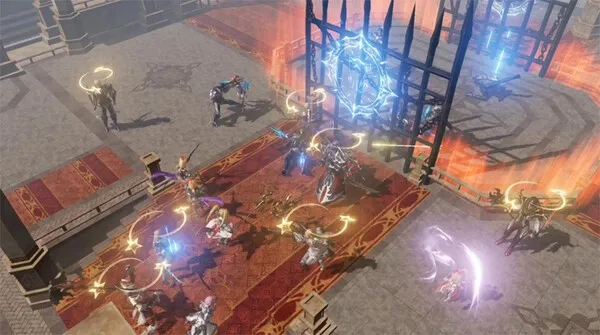
Allods Mobile / Data = Google Play

A, who worked at a major game company before starting a business as a solo developer, confessed, "Once development costs exceed 30 billion to 50 billion won, the success or failure of a project determines the fate of the entire company. When persuading management or the board of directors regarding business viability, it is much easier to prove how much of a system and BM (Business Model) with verified past revenue has been applied rather than presenting a fresh planning proposal. Therefore, there is a structural limitation where the development team has no choice but to follow safe hit formulas rather than taking risky challenges."
While it is difficult to predict user influx and revenue when attempting new genres and systems, it is relatively easy to explain business viability to investors and management when using IPs (Intellectual Property), genres, and BMs that have already accumulated success in the market.
The problem is that this is exactly where the paradox of massive development costs occurs. As the scale of production costs grows, game companies become gripped by the fear of failure, and to reduce risk, they ultimately choose verified genres and IPs again.
Furthermore, in the process of implementing verified BMs to quickly recover invested capital, growth methods and monetization structures that are all too familiar to users are reproduced once again. The rational choice within a company to lower its own risk ends up causing disillusionment for users, who feel that "another game with just a different name has come out."
In this process, the gap in perspective between game companies and users regarding development costs widens uncontrollably.
From the perspective of a game company, the result of hundreds of developers participating is naturally a blockbuster. Internally, it is highly likely that grueling work was performed to build new systems and content.
Industry insider B pointed out, "Companies pour massive costs into adopting the latest game engines and developing new technologies to reduce server overload. However, if the path a user experiences upon logging into the game does not escape the existing loop of 'auto-battle, equipment enhancement, daily tasks, and paid packages,' the cold reality is that no matter how much technology has advanced, it will inevitably look like an old game with a new skin to the user."
However, what users evaluate is not the invisible, painful development process, but the actual playable result on their screens.

If they download and run a blockbuster that supposedly had a massive budget, only to find the same boring auto-battles, enhancements, daily tasks, and constant prompts to purchase packages experienced in previous games, users cannot help but wonder, "Where on earth did all that development budget evaporate to?"
Lineage 2 Revolution / Data = Google Play
If the standard for a blockbuster defined by a game company is the development period, the number of personnel involved, and production costs, then the standard for a blockbuster defined by users is the actual fun and value they experience. If users accept the final product as a mere clone that has only changed the shell of an existing game, the game company must humbly accept that evaluation, no matter how many billions were spent.
Ultimately, the essential question facing the K-game industry is not "How much money and manpower did we invest?" If they cannot show tangible value that answers the question, "Why should users set down the games they already enjoy and start our new game?" then tens of billions of won in production costs will not be a point of pride, but a boomerang that triggers gamer cynicism.
When a blockbuster with a massive budget delivers nothing but the same monetization packages, enhancements, and battle passes, users feel a sense of "I had a hunch, and I was right." This is why self-deprecating voices emerge, asking if they are once again becoming victims of monetization models disguised as new releases.
To be continued in Part 3...
Related Article
Related articles