NHN builds Korea-Japan collaboration model for TGS 2026
NHN reveals a new global game strategy at TGS 2026, merging Korean development speed with Japanese gameplay design expertise.
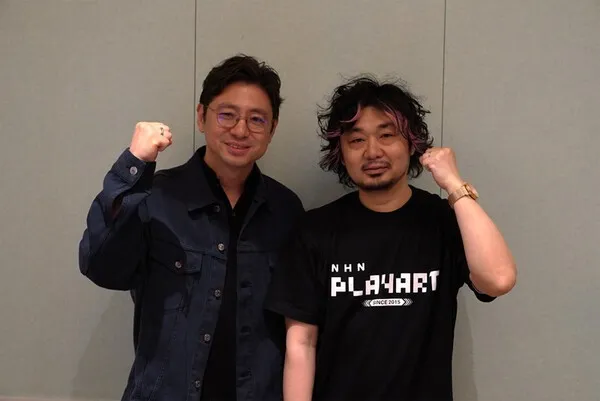
From left, Kim Sang-ho, Head of NHN Game Business Division, and Murakami Haruki, General PD of NHN Playart / Photo=NHN
| NBNTV = Jeong Dong-jin |
NHN has identified the synergy between Korea and Japan as a combination of speed and perfection, demonstrated through the joint development of 'Puchipoyon in the Fantasy World.'
According to NHN on the 18th, a group interview was held during TGS 2026 with the heads of the Korean and Japanese game business divisions to reveal a global game business strategy based on bilateral collaboration.
On the 18th, NHN conducted the interview at the New Otani Makuhari Hotel near Makuhari Messe in Japan, with Kim Sang-ho, Head of NHN Game Business Division, and Murakami Haruki, Director and General PD of NHN Playart, in attendance.
The session focused on more than just introducing new titles; it highlighted a collaboration model that combines the strengths of both companies to expand proven fun into original IPs.
Kim and Murakami explained that NHN and its Japanese mobile game subsidiary, NHN Playart, have been advancing their collaboration system over recent years by combining the strengths of the organizations in both countries. The division of labor is characterized by a structure that completes a single development cycle based on their respective expertise.
In this model, NHN Playart is responsible for designing the core gameplay until it satisfies users, while NHN implements and verifies this early on to complete it into a playable work. By repeating rapid development and verification after planning is finalized, they have simultaneously secured two values that are often in conflict: perfection and speed.
"The role of NHN Playart is to not compromise until the essence of fun is found," said Kim. "Since the working methods and cultures of Korea and Japan were different, an adjustment process was necessary in the beginning. However, after working in sync for several years, we have come to deeply trust each other's strengths. Now, a solid foundation for cooperation has been established where NHN can accelerate from the development stage once NHN Playart hands over a completed plan."
He also emphasized that by adding the rapid execution capabilities of the NHN development organization, they were able to increase the overall development speed without compromising the essence of the planning. Kim stated, "The effectiveness of planning is verified through direct play. We are focusing on keeping the development and verification cycle short to enable quick decision-making."
It was further explained that this collaboration is an extension of the Korea-Japan game business that NHN has built up for over 20 years. Starting with the establishment of Hangame Japan in 2000, NHN has accumulated game business know-how by moving between Korea and Japan. They confirmed success in the Japanese mobile game market with titles like Line Pop, and in 2013, they established the Japanese game entity NHN Playart, laying the foundation for their Japanese game business.
Exchange between the two organizations intensified when Zin took on the roles of CEO for both NHN and NHN Playart.
Moving beyond the initial stage of merely attending Korea-Japan events, the forms of exchange have diversified, broadening the cultural consensus between the two companies. These include Games Week, where members from both countries participate together; AI Sprinton, which performs AI utilization tasks in a short period; Korea-Japan Executive Workshops, where business directions and collaboration tasks are shared at the management level; and Korea-Japan New Employee Exchange programs, where newcomers learn each other's culture and working styles from the start.
Kim and Murakami explained that as these multi-layered exchanges accumulated, it naturally led to the joint development stage where both companies leverage their respective strengths to create a single game together.
NHN Playart has produced numerous major hits that have reached the status of national games in Japan, such as Yo-kai Watch Punipuni, which recorded 36 million downloads in Japan; the #Compass combat principle analysis system, which surpassed 20 million cumulative downloads in Japan in its 10th year; and Discidia Duel Room Final Fantasy, which has been steadily gaining popularity since its release last March.
In this interview, while introducing the achievements of such planning capabilities, the two also unveiled 'Puchipoyon in the Fantasy World' as the first joint project co-developed by NHN Playart and NHN.
'Puchipoyon in the Fantasy World' (Japanese title: Gensou Sekai no Puchipoyon) is the first fruit of collaboration between the two companies to secure next-generation original IPs, and it is one of the three new titles being revealed for the first time at TGS 2026.
The two companies stated that this work serves as a case study of how their collaborative system—combining NHN Playart's core gameplay design with NHN's rapid development execution—works in practice.
The process aims to confirm whether the successful gameplay formulas of existing hits can be successfully transplanted into new original IPs through this first collaborative model. They also announced the opening of Korean official sites and SNS channels so domestic users can stay updated on the game.
Murakami expressed hope that the title will demonstrate the results of combining NHN Playart's design with NHN's implementation and verification. Kim added, "'Puchipoyon in the Fantasy World' is both a result of our collaboration and a stage for verifying our process. We plan to expand this established collaboration method to future projects."
Kim and Murakami emphasized that the ultimate goal of the Korea-Japan collaboration is not just the success of a single title, but discovering collaborative methods through the process of building games together and expanding those methods to other projects.
At the scene, they discussed long-term global business directions, overcoming trial and error during the collaboration process, and plans for future joint projects.
Organizational and infrastructural improvements have also been made to increase the effectiveness of the Korea-Japan collaboration. NHN has established a new organization dedicated to Japanese business and Korea-Japan exchange, and has deployed specialized PMs capable of smooth communication in Japanese to support the two companies. Furthermore, they have increased efficiency by unifying video conferencing, translation, and task management through the integrated collaboration platform Dooray.
"Thanks to long-term exchange and accumulated experience, the Korea-Japan collaboration project targeting the Japanese market has successfully achieved its first fruit," said Kim. "NHN will continue to advance this collaborative structure to accelerate global game business expansion based on Korea-Japan cooperation."
He emphasized, "We will complete a process where Korea and Japan combine their respective strengths to create maximum synergy, presenting a collaboration model that can serve as a practical milestone for NHN's overall game business."
NHN Playart is NHN's Japanese mobile game subsidiary, which has successfully serviced various mobile games, including Yo-kai Watch Punipuni and #Compass, for long periods.
Participating in TGS 2026, which runs from September 17 (Thu) to 21 (Mon), NHN has set up a booth for the first time in eight years, showcasing a total of seven new and existing titles, including 'Puchipoyon in the Fantasy World.' Detailed information can be found on the dedicated special page (Japanese).
Related articles



![[TGS 2026] Bloomwalker: The Ni no Kuni successor arrives](https://global.nbntv.co.kr/images/sources/48a21dea-01d5-4534-9228-c9cac0bd66c8/thumb-400x225.webp)