Arian Gallery hosts 'After the Present: Each Their Own Universe'
Arian Gallery in Busan presents an international exhibition featuring 25 artists from 9 countries exploring time, memory, nature, and technology.
An international exhibition featuring artists from around the world exploring contemporary issues such as time, memory, nature, humanity, and technology has opened in Busan.
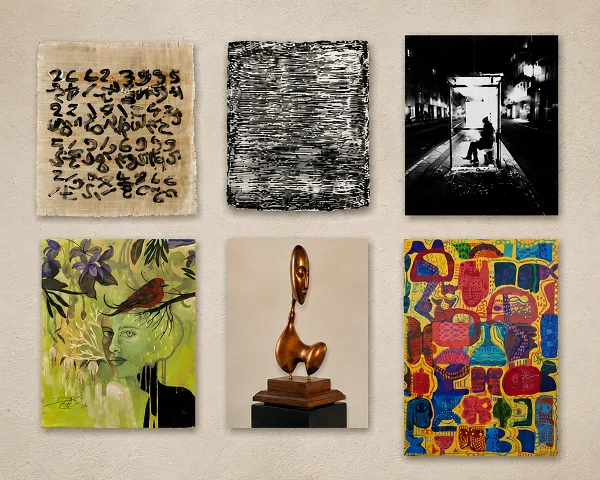
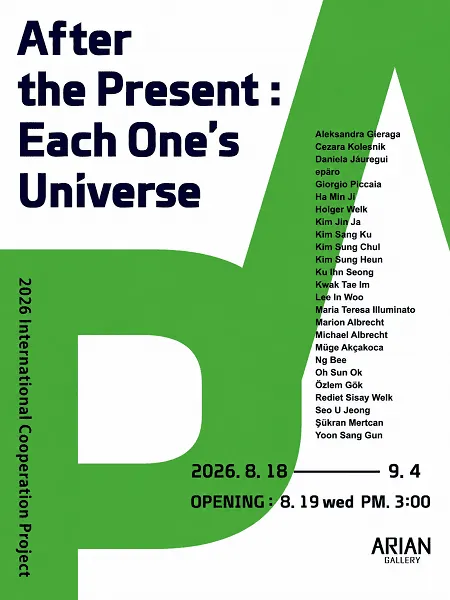
Arian Gallery in Haeundae-gu, Busan, is hosting the international exhibition 'After the Present: Each Their Own Universe' through the 4th. This marks the first installment of an international cooperation project series designed to foster continuous global artistic exchange.
The exhibition features 25 artists from nine countries, including Korea, Germany, Mexico, Malaysia, Ethiopia, Italy, Türkiye, Poland, and Belgium. The works span diverse genres and materials, including painting, printmaking, sculpture, installation, photography, and media.
The exhibition aims to examine how artists based in different regions perceive the contemporary era in an increasingly globalized world. Rather than classifying works by nationality, the exhibition is organized around recurring questions and modes of expression found across the diverse cultural and environmental backgrounds of the artists.
Curator Joo Ok Kim categorized the commonalities among the 25 artists into five major themes: time and memory, recovery and roots, the relationship between humans and nature, the relationship between materials and the hand, and the body and existence of modern humans.
In the first theme, viewers can encounter works that approach time and memory through various lenses.
Germany's Holger Welk captured urban solitude and anticipation through photography. Giorgio Piccaia translated the mathematical order of Fibonacci into visual compositions, while Maria Teresa Illuminato repurposed discarded materials as objects imbued with memory. Aleksandra Gieraga incorporated the concept of the 'Noosphere,' representing collective human consciousness, into her work.
While originating from different locations and materials, these works are connected by their ability to summon past time and memory into the present through contemporary creation.
The second theme, recovery and roots, explores resilience. Instead of simply restoring a lost paradise, Daniela Jáuregui depicted a world that can be rebuilt through memory and care. Rediet Sisay Welk viewed roots not as a fixed past, but as an entity that continues to shape present life. Both artists address the vitality that persists even after loss.
The third theme examines the relationship between humans and nature, questioning traditional perspectives that place humanity at the center of the world.
Müge Akçakoca from Türkiye focused on the cries of animals. Özlem Gök placed humans and dead birds on a single canvas to question human-centric hierarchies. Şükran Mertcan recorded the intersection of architecture and nature by combining the geometric structures of Byzantine architecture with botanical forms.
The fourth theme focuses on the relationship between materials and the artist's hand.
Ng Bee, Kwak Tae-im, Kim Sang-gu, Kim Seong-heon, and Yun Sang-geon utilize the production process itself as a formative element. Methods vary widely—from scratching, scraping, cutting, and pasting to carving woodblocks, leaving traces on Hanji (traditional Korean paper), or repeatedly processing metal. These techniques reveal the time and physical labor invested in the work through the traces left on the materials.
The final theme deals with the body and existence of modern humans, using technology, digital environments, desire, and instinct as primary subjects.
Marion Albrecht and Michael Albrecht explore the human condition within technological and digital environments. Kim Seong-cheol linked human desire to the concept of 'parasitism.' Ha Min-ji challenges the conventional view of the body as a tool trained for specific functions, while Eparo explored various human senses through the instinctive act of eating.
Rather than grouping the artists by nationality, the exhibition is structured to guide viewers through the shared inquiries of time, memory, nature, the body, technology, and desire.
Busan serves as the inaugural host for this international cooperation project. Following the Busan exhibition, the project is scheduled to move through various cities, including Türkiye, connecting artists across different regions and continents.
Professor Joo Ok Kim of Seoul National University of Science and Technology served as the curator. Yoon Sojung participated as a coordinator, and Kim Seong-heon managed the international cooperation planning.
Related articles