
mCloudBridge launches role-based Microsoft 365 Copilot training
mCloudBridge introduces specialized AI training for Microsoft 365 Copilot, covering everything from general tasks to IT development and automation.
| NBNTV = Ju Hyeon-ung |
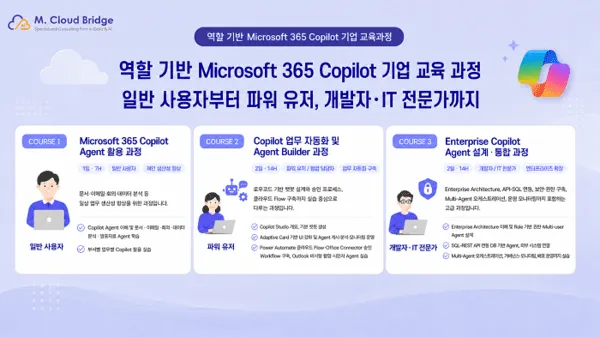
As the scope of corporate generative AI usage expands beyond document creation and information retrieval to include task automation and AI agent construction, the demand for practical training tailored to specific job roles is intensifying.
mCloudBridge has unveiled enterprise AI programs designed to train employees based on their specific roles, ranging from general staff to automation specialists and IT developers.
AI integrated business platform company mCloudBridge announced on the 11th the launch of its 'Role-Based Microsoft 365 Copilot Training Program' and 'Professional AI Competency Enhancement Training.' The curriculum focuses on applying AI tool utilization, task automation, and enterprise AI agent design to real-world business operations.
The Microsoft 365 Copilot training consists of three courses tailored to specific roles: general users, power users, and IT managers/developers. The general employee course provides hands-on practice in document creation, email processing, meeting summarization, data analysis, and presentation design using Word, Outlook, Teams, Excel, and PowerPoint.
The course for automation specialists and power users utilizes Copilot Studio and Power Automate. It covers chatbot and AI agent creation, REST API integration, workflow development, and the automation of approval processes, featuring practical business cases such as Outlook assistants and HR-related agents.
The IT manager/developer course provides training on permission management, external system integration, multi-agent configuration, governance, and deployment/operation.
The separate 'Professional AI Competency Enhancement Training' covers major generative AI services, including ChatGPT, Claude, Perplexity, and Gemini. Training focuses on practical field applications such as document summarization, research, contract review, report writing, and UI design.
Industry-specific courses are structured for 14 hours. In the shipbuilding sector, the curriculum covers English RFP analysis, classification rule review, and yard safety management. The manufacturing sector course covers equipment anomaly analysis and supply chain risk inspection.
The medical device and healthcare sector includes licensing/clinical document summarization and regulatory investigation, while the logistics sector includes driving log analysis, customs regulation investigation, and shipper contract review.
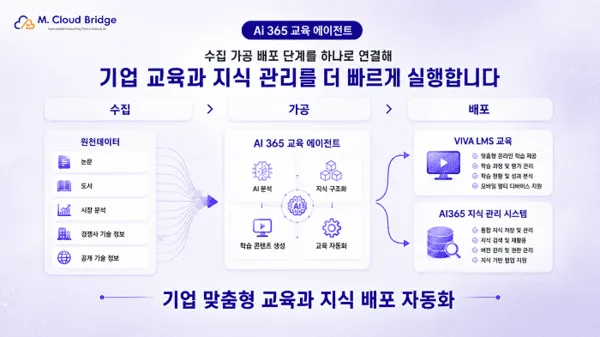
mCloudBridge also introduced the 'Ai 365 Training Agent,' which links corporate internal training with knowledge management.
The agent supports AI in analyzing and classifying dispersed information—such as research papers, market data, and internal documents—to be used as educational content and internal knowledge. It also provides data search and training course recommendation functions by linking with SharePoint and Microsoft Viva Learning.
"The adoption of AI by companies has reached a point where it must move beyond simple experimentation to actual business innovation and the establishment of operating systems," said Lee Hyuk-jae, CEO of mCloudBridge. "This training program focuses on helping each role—from general users to field automation specialists and IT organizations—systematically secure AI utilization capabilities, while enhancing a company's AI execution power by integrating training with knowledge management."



Comments 0