
AI revolution sparks global hegemony race: Korea's strategy for data sovereignty
As AI becomes a vital strategic weapon, Korea aims to transition from a consumer to a global rule maker by leveraging its semiconductor and IT dominance.
[AI Special Project ①] The 'AI Revolution' has spread to global hegemony competition... Korea's survival strategy for data sovereignty
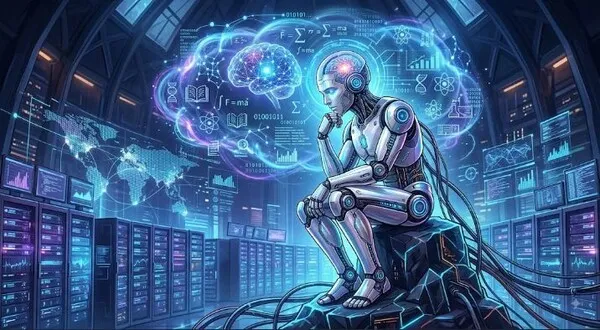
Artificial Intelligence (AI), which has broken through the intellectual limits of humanity, has become the most powerful 'strategic weapon' of the 21st century, wielding the fate of nations and corporations. Its overwhelming destructive power is going beyond advanced IT to completely transform the very fabric of conservative legacy industries. Through this special project, NBNTV focuses on the vivid scenes of companies such as POSCO, Samsung Electronics, Hyundai Motor Company, Coupang, and Dongwon Group that have innovated to their core through AI. Furthermore, we seek solutions for how the Republic of Korea can leap beyond being a mere consumer to become a 'global rule maker' in the era of superintelligence, where the boundaries between daily life and industry have collapsed.
Article Publication Order:
① The 'AI Revolution' has spread to global hegemony competition... Korea's survival strategy for data sovereignty ② AI breaks the fortress of legacy industries... moving beyond manufacturing and logistics to change the landscape of the recruitment market ③ AI changing the industrial landscape beyond daily life: What must we prepare? ④ The rule maker of the superintelligence era: The next leap to be completed by 'K-AI'
| NBNTV = Kim Min-ho
If the steam engine broke the limits of the human body and the internet broke the barriers of space, Artificial Intelligence (AI) is opening the prelude to a new civilization that breaks through the 'intellectual limits' of humanity. AI is no longer an unfamiliar future technology or a simple conversational chatbot. Today, AI is the greatest strategic weapon of the 21st century, controlling the rise and fall of nations and the survival of corporations, and is a massive wave itself that is overturning the entire global industrial ecosystem.
■ Explosive evolution achieved in half a century... From simple chatbots to 'AI that thinks for itself'
Of course, AI did not possess such destructive power from the beginning. Since the concept first emerged in the mid-1950s, early AI remained at a basic, rule-based level that only output predetermined answers according to input keywords. It also experienced long periods of stagnation due to technical limitations and investment droughts.
However, in May 1997, the landscape shifted. IBM's AI computer 'Deep Blue' defeated the world chess champion Garry Kasparov. Although Deep Blue, designed specifically for chess, was dismantled after the match, this confrontation became a historical turning point that imprinted the infinite possibilities of big data-based algorithms on the world. The data processing and calculation algorithms used at that time became the fertile foundation that later sprouted modern AI technologies, such as drug discovery and financial risk assessment.
■ The shock of 'Deep Blue' dropping the chessboard, blooming into 'Deep Learning' that changes the constitution of all industries
The decisive momentum for AI to leap to a level that changes human daily life was the emergence of 'Deep Learning' technology in the 2010s. Moving away from the past where it only moved according to formulas provided by humans, Deep Learning-based AI began to 'self-read' patterns within vast amounts of data and infer optimal answers.
This technological evolution penetrated deep into industrial sites at a speed much more destructive than expected. Beyond simple office automation, even conservative legacy industry groups such as manufacturing, finance, distribution, and medical sectors have jumped into a race for AI adoption to survive. As AI becomes the core engine for building hyper-personalized services and precise prediction systems, the global industrial ecosystem has transformed into a battlefield where lives are truly at stake.
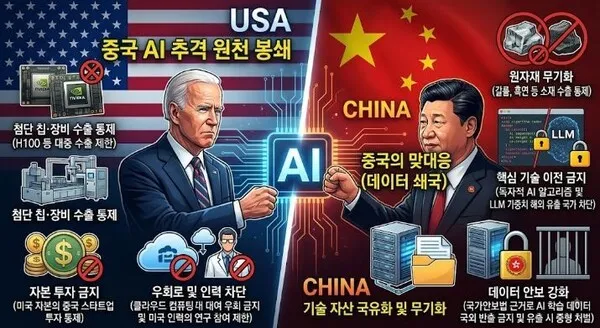
■ US-China hegemony war pouring in 270 trillion won... Technology blockade and weaponization of resources
If the rise and fall of the past Industrial Revolution were determined by the steam engine, electricity, and communication, the victory or defeat of the 4th Industrial Revolution depends solely on 'AI technological prowess.' The United States and China, which divide the global economy, identified AI early on as a top-tier strategic asset involving national security and future growth engines, and have entered a hegemony war from which they cannot retreat.
The United States is fundamentally blocking China's pursuit by setting up a dense 'triple net' of technology blocking, capital control, and surveillance of indirect routes. In response, China is strengthening internal unity through the nationalization of technology assets while fiercely responding with the 'weaponization of resources' by controlling exports of core minerals essential for AI hardware, such as gallium, germanium, and graphite.
■ The arrival of the 'Sovereign AI' era... Korea, a 'semiconductor and IT powerhouse,' holds the key to a counterattack
Amidst the clash of superpowers, the market dominance of Big Tech companies is intensifying daily. The annual AI investment of the top four U.S. Big Tech companies—including MS, Alphabet, Meta, and Amazon—has exceeded 270 trillion won, and the top three companies also control more than half of the global cloud market.
Feeling a sense of crisis over such extreme technological monopolies and cultural dependency, countries around the world are racing to build their own 'Sovereign AI' models that fully reflect their own data, infrastructure, and cultural values. This is a national survival task that South Korea can no longer postpone.
Fortunately, Korea is one of the few powerful nations holding a definitive counterattack card amidst these massive waves. Not only has it established world-class IT infrastructure, but Samsung Electronics and SK Hynix also control 80% of the global HBM (High Bandwidth Memory) market, which is called the heart of AI, thereby securing the core supply chain. Furthermore, Korea has built its own Large Language Model (LLM) ecosystem, including Naver (HyperCLOVA X), LG (EXAONE), and SKT (A.).
What if Korea's overwhelming semiconductor hegemony, proprietary AI platforms, and world-class manufacturing and medical infrastructure are meticulously combined? South Korea will be able to leap beyond being a mere consumer swept up by the global AI wave to become a key leader writing the new rules of the superintelligence era.
*Notice from NBNTV: This article was proofread and refined using AI after being written by the author. Images generated by AI are noted in their respective captions.
Related Articles
- [AI Special Project ④] The rule maker of the superintelligence era: The next leap to be completed by 'K-AI'
- [AI Special Project ③] AI changing the industrial landscape beyond daily life: What must we prepare?
- [AI Special Project ②] AI breaks the fortress of legacy industries... moving beyond manufacturing and logistics to change the landscape of the recruitment market

Comments 0