
Korea Deep Learning unveils roadmap to advance 'working AI'
Korea Deep Learning expands its 'Deep Agent' solution into an AI worker capable of business judgment, approval, and system execution.
| NBNTV = Joo Hyeon-ung |
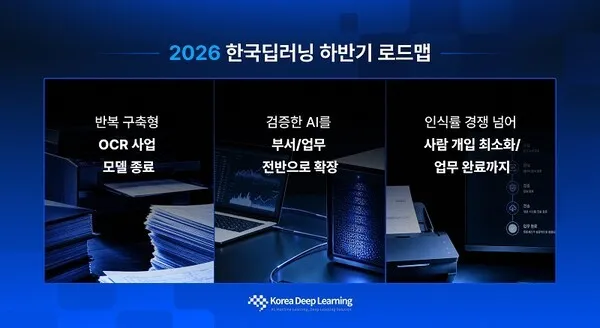
Korea Deep Learning (CEO Gim Ji-hyeon), a provider of visual intelligence AI solutions for the public and corporate sectors, has announced a second-half roadmap to expand its document AI solution, 'Deep Agent,' into an AI worker capable of performing actual business tasks.
The roadmap focuses on expanding traditional OCR-centered automation—which was limited to extracting characters and information from documents—to include business judgment, approval, and the execution of corporate systems.
Previously, whenever a company added a new document type or task, a separate OCR system had to be built and its recognition rate verified. Korea Deep Learning is shifting to a model where once-verified models and business standards are stored as operational assets and reused across different departments and tasks.
The core foundation of this shift is 'VLM Ops.' AI models, prompts, information extraction schemas, and quality standards used in specific tasks are accumulated in VLM Ops. When a new task is introduced, instead of developing a system from scratch, users can simply adjust and verify only the necessary components for implementation.
The company also plans to provide features that allow customers to respond directly to changes in document formats or extraction items. This aims to reduce the burden on clients to request maintenance from developers every time key-values change, allowing them to directly configure and tune necessary items within VLM Ops.
Korea Deep Learning is also broadening its evaluation criteria for document AI, moving from simple recognition rates to human non-intervention rates and task completion rates. The company intends to measure automation performance not just by how accurately a document is read, but by how much of the actual business process can be completed without human verification.
The models and business standards stored in VLM Ops are linked to agent workflows. This creates a seamless flow consisting of document classification, information extraction, cross-verification between documents, business judgment, manager approval, and subsequent system execution.
For standard cases that meet specific reliability standards, Deep Agent handles all subsequent procedures. Only exceptional cases, where information is unclear or requires specialized judgment, are passed to a manager for review.
Results that have completed review and approval are integrated with existing corporate systems, including ERP, CRM, EDMS, and RPA. The AI's reasoning, approval/review history, and system execution results are also stored to support auditing and internal controls.
The company is also strengthening its verification structure to minimize incorrect AI judgments. Using OCR and parsers, the system recognizes characters and document structures, analyzes context and business meaning using Vision Language Models (VLM), and then compares the extraction results with the original text positions.
Results that deviate from set formats or exhibit low reliability are isolated from standard cases. This prevents information lacking sufficient evidence from being entered into downstream systems without verification.
Korea Deep Learning is currently deploying Deep Agent for merchant onboarding and modification screening at a domestic credit card company. The solution automatically classifies subscription/change applications, business registration certificates, copies of bankbooks, and certified copies of all registered matters, while cross-verifying key information across documents.
For standard cases, the system automatically handles personal information masking and integration with screening systems, leaving only cases requiring additional verification for manual review. The models and business standards verified during this process will be stored in VLM Ops for use in other merchant screening tasks.
Korea Deep Learning has defined this direction as the '3 Zero AI Worker Strategy.' It consists of 'Zero Training,' which reduces repetitive learning and settings; 'Zero Hallucination,' which minimizes incorrect judgments by utilizing original texts and verification rules; and 'Zero Review,' which focuses on checking only exceptional cases rather than performing full inspections of all standard cases.
“We will move away from rebuilding OCR every time a new document or task is added and instead expand verified AI and business standards across the entire enterprise,” said Gim Ji-hyeon, CEO of Korea Deep Learning. “The goal of this roadmap is to reduce the costs of repetitive construction and inspection while creating a structure where AI completes actual business tasks.”


Comments 0