
AI reshaping industrial landscapes: How should we prepare?
From aviation to medicine, AI is transforming legacy industries. Explore the impact of AI Transformation (AX) and the future of work.
[AI Special Project ③] AI is moving beyond daily life to reshape the industrial landscape: How should we prepare?
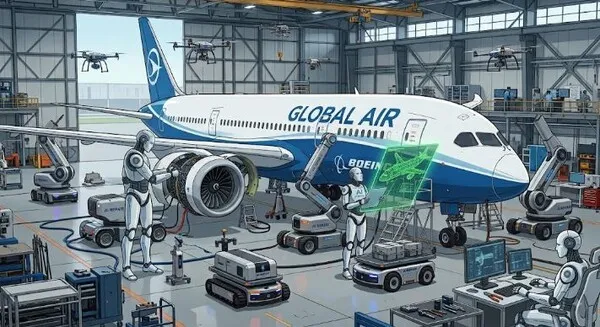
Artificial Intelligence (AI) has broken through the intellectual limits of humanity, becoming the most powerful 'strategic weapon' of the 21st century, wielding the fate of nations and corporations. Its overwhelming disruptive power is moving beyond advanced IT to completely transform the fabric of conservative legacy industries. Through this special series, NBNTV focuses on the vivid scenes of companies such as POSCO, Samsung, Hyundai Motor, Coupang, and Dongwon Group that have innovated to their core through AI. Furthermore, we seek solutions for how Korea can leap forward as a 'global rule maker' in the era of superintelligence, where the boundaries between daily life and industry have collapsed.
Article Sequence:
① The 'AI Revolution' spreading into global hegemony competition... Korea's survival strategy for data sovereignty
② AI breaking the fortress of legacy industries... Moving beyond manufacturing and logistics to change the recruitment market
③ AI, which is moving beyond daily life to reshape the industrial landscape: How should we prepare?
④ The rule maker of the superintelligence era, the next leap to be completed by 'K-AI'
(An image generated by AI to aid understanding of the article. Google Gemini Nano Banana)
| NBNTV = Kim Min-ho |
AI is moving beyond a supporting role that helps with limited tasks in specific industries, leveraging its unique advantages to pioneer new business domains. Moving beyond simply increasing human work efficiency, the current goal of the AI industry is to replace humans themselves and create extreme efficiency. As AI establishes itself as a massive industrial sector, it is naturally expanding its influence to where capital is concentrated.

■ Piercing through high-level expertise... Aviation maintenance and drug discovery
Today, AI is widely utilized across industries requiring high levels of expertise, moving beyond the simple stage of information collection. Korean Air recently collaborated with LG CNS and Amazon Web Services (AWS) to build a 'Maintenance Defect Analysis System' using generative AI and cloud technology after approximately six months of development.
In this new system, when a mechanic enters defect symptoms in natural language, the AI understands the context and immediately finds related maintenance history and similar cases. Abbreviations and unstructured records written in the field are processed into standard sentences, and key information is automatically extracted. Although aviation maintenance is a field with very high entry barriers—requiring completion of related departments, obtaining certifications, and years of practical experience—AI has perfectly proven its utility by reducing the time and cost required for technical information analysis and decision-making.
The performance of AI in the medical and pharmaceutical industries is also dazzling. The task of searching for new drug candidates, which previously took an average of 4 to 5 years, has been drastically shortened to as little as a few months or up to a year following the introduction of AI. During the development of COVID-19 treatments, AI also precisely analyzed the 3D structure of the virus to rapidly derive optimal compound structures. In addition, in fields directly linked to human life, AI is doing the work of hundreds of people, such as predicting cardiac arrest by tracking the vital signs of hospitalized patients in real-time or selecting clinical trial subjects using big data.
■ Replacing human faces and voices... The AI craze in broadcasting and distribution
As AI continues to advance, the hottest topic to emerge is 'Can AI fully replace humans?' And the market response is already hardening toward "YES."
(An image of J-na, an AI announcer in Jeju Island, hosting local news. Photo = Jeju Special Self-Governing Province website capture)
(An image of an NS Home Shopping AI shopping host conducting a home shopping broadcast. Photo provided = NS Home Shopping)
Since the first TV broadcasts began in 1929, AI is now replacing even broadcasting, which has been a unique human domain for nearly 100 years. MBN was the first in Korea to deploy an AI anchor trained on anchor Kim Ju-ha for regular news, and Jeju Special Self-Governing Province introduced the AI announcer 'J-na.' J-na does not stop at simply reading scripts; she analyzes weather data to compose weather forecasts herself. Furthermore, NS Home Shopping has presented a win-win model by deploying AI-based shopping hosts in actual broadcasts to reduce production costs and supply products at lower prices.

■ Differing dreams regarding AI Transformation (AX)... The dilemma of job insecurity and cost reduction
While there is no disagreement that AI has maximized work efficiency, the path toward the full-scale era of AI Transformation (AX) is marked by intense labor-management conflicts.
From the perspective of workers, the introduction of AI means a threat to jobs. If one AI replaces the work of 10 people, the remaining workforce faces job insecurity, and the intensification of unemployment due to reduced new hiring is unavoidable.
Conversely, the corporate view is entirely different. Introducing humanoid robots (Physical AI) to industrial sites can yield massive long-term cost savings. Robots are easy to replace or repair when damaged, reducing industrial accident risks, and they are free from financial variables caused by labor relations, such as strikes or wage increases. For companies driven by profit, this is an irresistible advantage.
In fact, this year, the Hyundai and Kia labor unions raised job security issues following the introduction of AI and robots as a core agenda during negotiations with the companies. When Hyundai Motor Group unveiled the humanoid robot 'Atlas,' the union maintained a hardline stance, stating, "Field deployment without labor-management agreement is absolutely impossible.'
■ Challenges for new coexistence... Labor-management agreement and future job creation
When computers were first introduced to industrial sites, there was also fear of mass unemployment. However, computers ultimately created new jobs and innovatively improved the work environment. AI, too, may not be a predator simply stealing human jobs, but rather a foundation for sustainable growth and a source of new opportunities. As we approach the AX era, it is time for labor and management to move beyond confrontation and seek answers for coexistence through compromise and communication to ensure that technological progress benefits everyone.
*Notice from NBNTV: This article was proofread and refined using AI after being written by the author. Images generated by AI are noted in the photo captions.
Related Articles
- [AI Special Project ④] The rule maker of the superintelligence era, the next leap to be completed by 'K-AI'
- [AI Special Project ②] AI breaking the fortress of legacy industries... Moving beyond manufacturing and logistics to change the recruitment market
- [AI Special Project ①] The 'AI Revolution' spreading into global hegemony competition... Korea's survival strategy for data sovereignty


Comments 0