
"My peers are playing golf..." The reality faced by basic science researcher Dr. Lee Won-young in Antarctica
Dr. Lee Won-young, a researcher at the Korea Polar Research Institute, appeared on the tvN variety show "You Quiz on the Block" to share her journey from studying magpies to researching penguins in Antarctica. She candidly discussed the hardships of being a basic science researcher, including financial struggles and the psychological gap between her life and that of her peers.
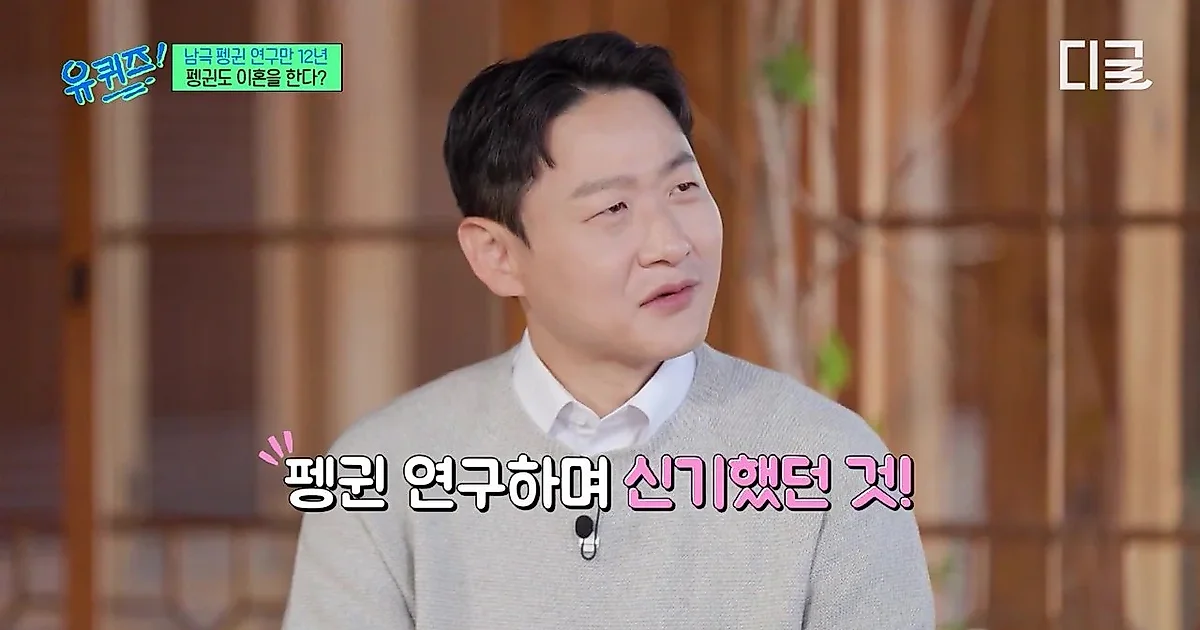
The path of a scholar researching basic science is filled with deep, realistic struggles as much as it is with brilliant achievements. In the recently aired tvN variety show "You Quiz on the Block," Dr. Lee Won-young, who studies animal behavior at the Korea Polar Research Institute, appeared to calmly recount her life as an ecologist, ranging from magpie research to penguin research in Antarctica.
From being 'targeted' by magpies during her Seoul National University days to heading to Antarctica
Dr. Lee Won-young is a student of Professor Choe Jae-chun, an authority in the natural sciences field. After entering the Department of Biological Sciences at Seoul National University, she joined Professor Choe's research team and devoted herself to magpie research for over six years. At that time, she studied the parental behavior of 40 pairs of magpies on campus, and during this process, she was even recognized as an 'intruder' by the magpies and attacked. Recalling the situation in the video, Dr. Lee shared how the magpies selectively reacted only to her among the 5,000 students in a single grade, striking at her nest. She revealed that even when she brought a colleague wearing the same clothes to continue the research, she experienced the magpies seemingly recognizing her and following her.
The reality she faced after obtaining her doctoral degree was not easy. Dr. Lee confessed that she struggled while job hunting for about three months after receiving her degree. This was because, due to the nature of basic science fields, it is rare for corporations to seek researchers. Noting that penguins are also birds, she came across news of recruitment at the Korea Polar Research Institute and headed to Antarctica through a process of directly applying for and securing research funds. She mentioned the realistic situation where one might hear, "You are welcome to come, but you must bear the labor costs yourself," conveying the hardships faced by many PhDs in basic science fields.
"Penguins divorce just like humans"... The mysteries of life observed by an ecologist
Dr. Lee, who has traveled to Antarctica ten times to study penguins, discovered similarities between penguin ecology and human society. In particular, regarding the breeding and mating habits of penguins, she explained, "It is not much different from how humans live." In the case of emperor penguins, she pointed out that while about 90% maintain monogamy, not all individuals stay with one partner for their entire lives. She cited breeding success rates as the reason for the 'divorce' phenomenon where partners change. She introduced research cases showing that if the breeding success rate is low because they fail to raise offspring well, the probability of changing partners the following year increases.
Furthermore, she shared the emotions she felt while witnessing the devotion of parents during the penguin parenting process. She said that the sight of penguins climbing up and down rugged terrain to bring food to their chicks is not much different from the image of parents dedicating themselves to raising their children. After 10 years of research, Dr. Lee achieved the result of publishing a paper in the journal Science, but she added that research achievements do not necessarily lead to economic rewards, mentioning the reality in academia where researchers must directly bear the paper publication fees.
Cruise ships and isolated islands, the lonely mission of an ecologist
Dr. Lee candidly confessed the psychological conflict arising from the social gap between her and her peers. Seeing her peers who entered fields such as medicine and enjoy economic abundance, she confessed that she sometimes felt anxious about the path she had chosen. In particular, when she was isolated on an island due to bad weather, she shared that while looking at the tourist cruise ships visible in the distance, she thought, "We are in the same space, but living in different worlds."
Nevertheless, she did not lose pride in her profession. She expressed satisfaction with her current life, mentioning that her 'geeky' nature of loving to observe animals since childhood made her current research possible, and that her peers actually envy her work. She emphasized that basic ecological research will remain a precious field in the future, stating, "The most fundamental field observation data is accumulated only when ecologists themselves roam the field and bring it back."
Han Ah-reum reports for NBNTV Global, mainly covering K-Variety and also writing on K-pop and K-drama.
Related Articles

Choi Hyun-woo Reunites with 25-Year Friend Lee Sun-jung... "BTS Jung Kook's Hobby is Also Card Magic"

"Failure is the process of accumulating experience"... The growth and goals of gold medalist skateboarder Kang Jun-i

Comments 0