
"High-income single-person households can also be isolated"... Professor Kim Su-yeong of Seoul National University discusses the flip side of the 'Ultra-Solo Society'
Professor Kim Su-yeong of Seoul National University explains the shifting demographics and social risks of the rising single-person household trend, noting that even high-income individuals face social isolation.
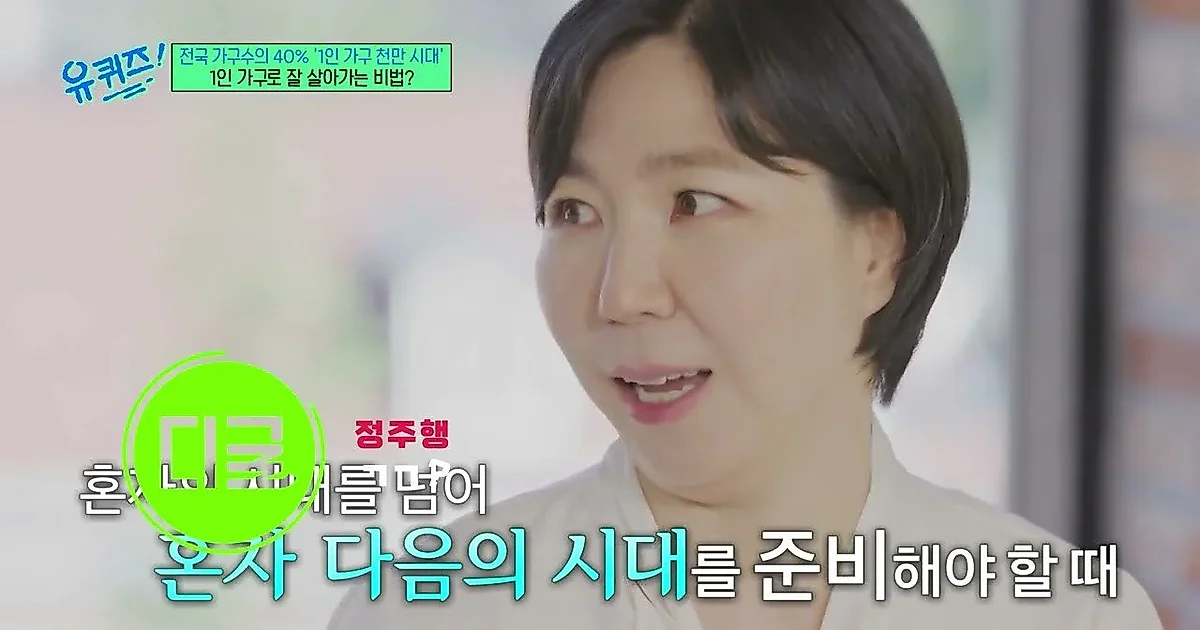
South Korea is rapidly entering an 'ultra-solo society' as it reaches the era of 10 million single-person households. Moving beyond the previous trend of shifting from large families to nuclear families, living alone is now establishing itself as a universal social structure.
4 out of 10 households are single-person households... High proportion of professionals and freelancers
Professor Kim Su-yeong of the Department of Social Welfare at Seoul National University pointed out the current social changes by mentioning the rapid increase in single-person households. According to Professor Kim, single-person households, which were at the level of approximately 5 million in 2015, have surged over 10 years to reach approximately 10 million currently. This figure accounts for about 40% of all households. This phenomenon is a global trend, including Sweden (over 60%), as well as in South Korea.
In particular, the change in the population composition and income classes of single-person households is noteworthy. Single-person households appear evenly across all age groups, from those in their 20s to those in their 70s and older. In the past, welfare policies were mainly discussed centered on low-income groups or elderly people living alone, but in actual statistics, professionals and related workers account for the highest proportion at 22%. Professor Kim explained that single-person households are heavily concentrated in occupations where individual performance and personality are emphasized or where work patterns are irregular, such as the finance industry, cultural industry, arts, IT industry, and freelancers.
Isolation created by 'distinction' culture... High-income groups positioned in 'depressive groups'
Professor Kim explained the gap between social common sense regarding single-person households and the actual reality. While it is easy to think of single-person households as individualistic, they often show familial tendencies with a strong attachment to their original families (parents, siblings). In particular, there are many unmarried individuals who support parents instead of married siblings.
On the other hand, in the case of high-income single-person households with economic abundance, they face a new social risk called 'isolation.' Professor Kim pointed out that there are many cases where high-income single-person households unintentionally experience social isolation due to a culture of 'distinction,' where they only interact with people who have similar tastes and culture. He noted, "High-income single-person households are heavily positioned in isolated depressive groups," citing the phenomenon where social networks narrow despite having economic abundance as a regrettable point.
In fact, Professor Kim emphasized that the risk of isolation is not limited to specific classes by mentioning cases of solitary deaths among highly educated groups that were reported through the media in the past. Through his personal experience of his cousin, who was working as a freelancer, dying of acute myocardial infarction, he conveyed the reality that single-person households without a fixed workplace or colleagues may experience delays in being discovered during emergencies.
Even when living alone, 'separately yet together'... Preparing for a sustainable life
To respond to the era of rapidly increasing single-person households, Professor Kim suggested three specific preparations. The first is economic preparation. He advised securing up to 6 months' worth of living expenses for emergencies and preparing health-related measures such as pensions and indemnity insurance for old age.
The second is the construction of a 'Second Family.' He explained the need for social relationships where people who are not blood-related but can trust each other gather to create a care safety net and an emergency contact network. The last is managing eating habits. As it has been found that the incidence of chronic diseases in single-person households is 2.7 times higher than in general households, it is important to maintain a healthy diet even when living alone.
Professor Kim emphasized, "Since humans are social beings, even if they live alone, they are ultimately beings who must live together," adding, "It is time to socially contemplate together about life 'after being alone' after passing the era of living alone."
Han Ah-reum reports for NBNTV Global, mainly covering K-Variety and also writing on K-pop and K-drama.
Related Articles

"It Should Be 50-50"... Conflicting Insurance Claims Emerge Over 'Stealth Vehicle' Accidents on Night Roads
Eva Popiel, "I Must Quit Bread"... Chronic Inflammation Confirmed via Blood Test and Dietary Advice

Comments 0