Machim Keyboard Applies Hangul Composition Principles, Seeks Patents in South Korea and China
Developer Ahn Nam-young says the Machim mobile keyboard reduces finger travel and taps by applying Hangul’s syllable-composition principles.
Naeoe Economy TV — A mobile keyboard called Machim has been developed with a layout intended to reduce both the distance a user’s finger must travel and the number of keystrokes required when entering Hangul on a mobile phone.
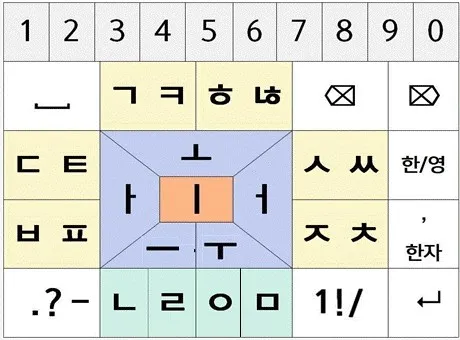
Developer Ahn Nam-young said he created the Machim keyboard by arranging consonants and vowels around the vowel “i” and enabling users to enter multiple letters by linking them with a swipe across the screen. Patent applications have been filed in South Korea and China under the title “Text Input Method and Device.”
The Machim layout places the principal vowels “i,” “a,” “eo,” “o,” “u” and “eu” in the center of the keyboard. Four consonants frequently used as final consonants—“n,” “l,” “ng” and “m”—are positioned in the lower central area. According to the developer, placing frequently used letters close to one another shortens the distance a finger must move while forming characters.
In addition to conventional touch-and-press input, the keyboard incorporates a swiping function that connects letters. By moving a finger from the central “i” toward the surrounding simple-vowel positions, a user can enter 13 of Hangul’s 21 vowels.
Compound vowels are entered by swiping consecutively through the positions of their related simple vowels. Connecting “o” and “a,” for example, produces “wa,” while connecting “u” and “eo” produces “wo.” To enter “wae,” the keyboard is configured so that the user follows the positions of “o,” “a” and “i” in order with a single continuous swipe.
The keyboard also includes a function that automatically generates the initial silent consonant used when a Hangul syllable begins with a vowel. After pressing the space key, users can enter a vowel without separately selecting that initial consonant. Grammatical particles such as “eun” and “neun,” or “eul” and “reul,” as well as endings including “-da,” “-go” and “-seo,” can also be entered with swiping gestures.
In an in-house test conducted by the developer’s side, the 63 characters of the Korean “Pledge to the National Flag” were entered with 105 keystrokes using Machim. The recorded totals for the other layouts were 186 for Cheonjiin, 173 for Naratgeul, 156 for Vega, 125 for Hansonmoaki, 124 for Danmoeum and 121 for QWERTY.
On the basis of that test, Machim required approximately 44 percent fewer input actions than Cheonjiin. The comparison reflects the results of this particular 63-character test rather than a universal measure of typing performance.
Actual typing speed and ease of use may vary according to a user’s familiarity with a keyboard, the sentence being entered and the mobile-phone environment. The keyboard will also need to be tested with a diverse group of users before it is commercialized.
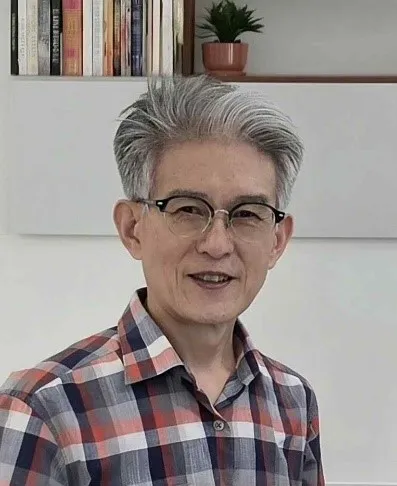
Ahn, the author of “Kkachilhan Urimal,” conceived the new keyboard after retiring and spending about 10 years teaching Korean to foreigners. He focused on the difficulty Korean-language learners experience when combining final consonants and vowels, and reflected Hangul’s syllable structure in the keyboard arrangement.
“The Machim keyboard was designed so that users can type while understanding Hangul’s composition principles,” Ahn said. “I hope it will be used as a new input method by foreign learners of Korean and people using a mobile phone for the first time.”
Related articles