“Let’s hold hands and go together”... The moving resonance of ‘Alone’
The Mapo Cultural Center Gugak Orchestra celebrated its 1st anniversary with a moving performance featuring veteran singer Seo Yu-seok.
"Even if it's hard on the way, let's hold hands and go, let's go together..."
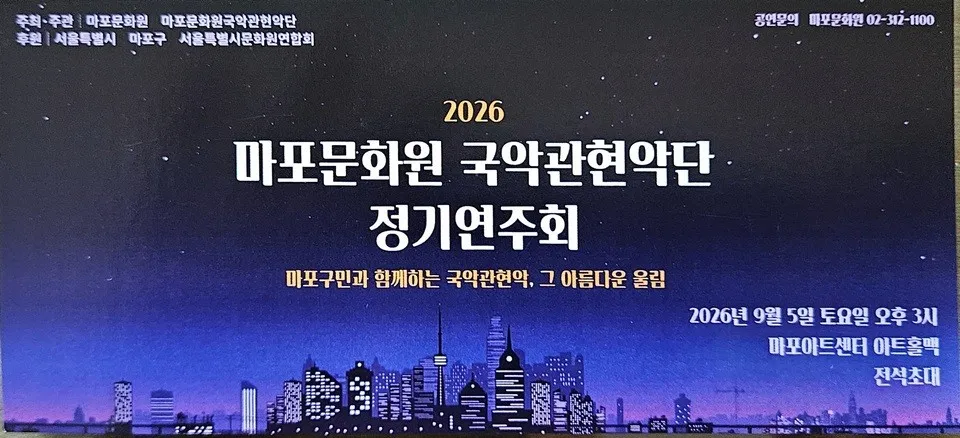
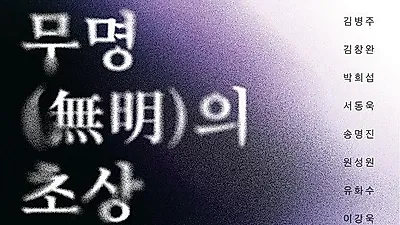
[Poster for the Mapo Cultural Center Gugak Orchestra regular concert]
Grand melodies of traditional Korean music (Gugak) echoed through the concert hall, blending with the moving chorus of the audience. As singer Seo Yu-seok performed the encore song 'Alone,' bursts of enthusiastic cheers and applause erupted from all corners of the seats. The magnificent scene concluded as a masterpiece that has deeply touched the public met the profound resonance of the Gugak orchestra, leading the entire audience to sing in one voice.
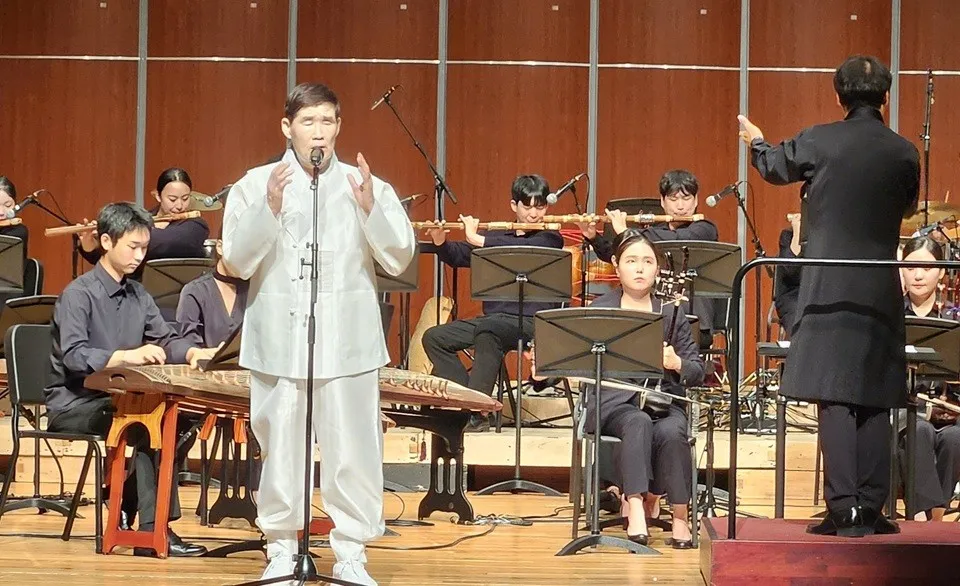
Singer Seo Yu-seok added depth to the emotion by performing 'Ganeun Sewol' and 'Alone' accompanied by the Gugak orchestra. (Photo = NBNTV)
The Mapo Cultural Center Gugak Orchestra, which is hosted by the Mapo Cultural Center and has an operational agreement with SOUL KOREA, successfully held its regular concert at the Mapo Arts Center Art Hall Mac at 3 PM on the 5th to celebrate its first anniversary.
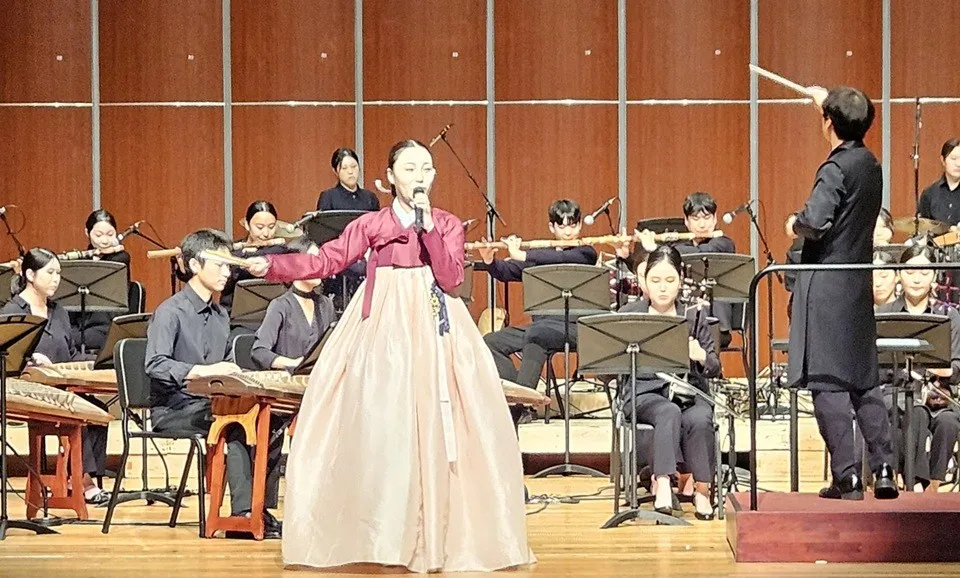
The concert opened brilliantly with a grand performance of the first piece, 'Sinnaerim.' Following this, singer Kim Su-yeong took the stage to perform 'Ssukdaemeori' and 'Heungbuga' from the pansori 'Chunhyangga,' heightening the excitement of the venue. The audience responded with friendly traditional exclamations such as "Eolssigu jota!" (Bravo!) and "Jalhanda!" (Well done!), creating a stage where the performers and the audience breathed as one.
Singer Kim Su-yeong added excitement by performing 'Ssukdaemeori' and 'Heungbuga' from Chunhyangga. (Photo = NBNTV)
The highlight of the performance was the collaboration with the veteran singer of the popular music scene, Seo Yu-seok. Seo presented his signature songs 'Ganeun Sewol' and 'Alone' accompanied by the Gugak orchestra. His rich, seasoned voice, harmonizing with the traditional melodies, added a bountiful autumnal elegance and provided a deep resonance to the audience.
Under the delicate and dynamic conducting of Won Young-seok, young Gugak musicians—centered around Director Kim Eun-jeong and Artistic Director Kim Seok-eon—completed a diverse stage where the depth of traditional music and modern interpretation harmonized. After enjoying the festive atmosphere until the final piece 'Chukje' (Festival), the audience offered generous applause and cheers, even through the encore stage.
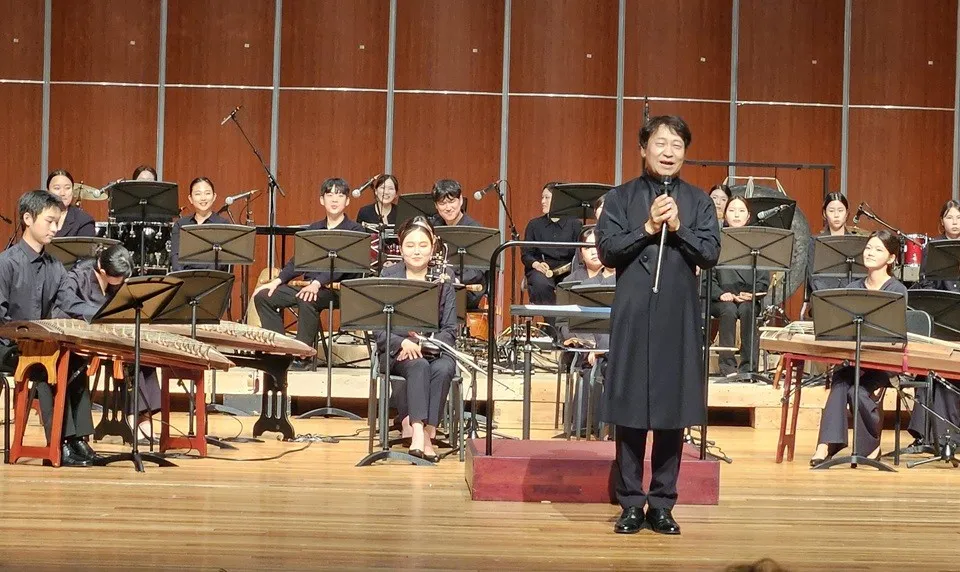
Professor Won Young-seok, considered one of the top conductors in the domestic Gugak scene, explains the content of the piece to the audience. (Photo = NBNTV)
Director Kim Eun-jeong stated, "With young Gugak musicians at the center, we will continue to make new musical attempts and various performances so that traditional music can be preserved and inherited while becoming more familiar to the audience."
Meanwhile, the Mapo Cultural Center Gugak Orchestra has been steadily communicating with the local community through various performances for the residents of Mapo since its founding. With this regular concert marking its first anniversary, the orchestra is strengthening its status as a representative cultural and arts group of the region and raising expectations for its future activities and growth.
□ Interview with Conductor Won Young-seok
“It is okay to go a little slower, so I hope you contemplate your own music for a long time..."
- You took charge of the conducting in this performance, and we heard there was a special reason. First, how do you feel about participating in this stage?
This performance is quite meaningful to me personally. Above all, it is special that a student I taught at school is now creating this performance together with me in the position of an artistic director.
Meeting a former student after time has passed and now creating a single stage as a conductor and an artistic director is something I find rewarding as a music educator.
- A teacher and a student have met in the positions of conductor and artistic director. What did you feel while working together?
Although our roles have changed, I felt that our hearts toward music are ultimately the same. Since the artistic director looks at the overall direction of the performance and the conductor plays the role of turning that direction into actual music, they must communicate closely.
We prepared for the performance by sharing opinions this time as well, and seeing my student create a performance with their own thoughts made me think, 'They are truly walking their own path as a musician now.'
- This performance is being conducted based on the operational agreement between SOUL KOREA, which is centered around young artists, and the Mapo Cultural Center Gugak Orchestra. What kind of role will be needed in the future?
For the orchestra to continue its good activities, I believe that not only performing but also planning, operation, and various cultural and arts networks must work together.
In that sense, it is meaningful that SOUL KOREA and the Mapo Cultural Center Gugak Orchestra are sharing roles and working together through this operational agreement. Having young artists at the center to plan performances and engage in various artistic attempts can serve as a great stimulus for the Gugak community.
I hope that Korean cultural arts, including Gugak, will not stay only within the country but will play a role in moving toward a wider global stage.
It is important to create opportunities for young artists to exchange with international artists and gain new musical experiences. Therefore, if SOUL KOREA grows into a platform that facilitates these encounters, it will play a very meaningful role.
- From your perspective as someone who has taught music for a long time, what do you think young musicians need most today?
Fundamentally, they need steady study and their own unique thoughts. While mastering performance techniques is important, they must eventually possess their own musical color as time passes.
Furthermore, the experience of making music with others is crucial. Performing well alone is one thing, but creating great music together is a different skill entirely.
- What are your thoughts on the future of Gugak orchestra music?
Gugak orchestra music is a genre with immense potential for development, even though it is rooted in tradition. The key is to preserve tradition while constantly seeking new expressions that fit the times.
If young performers experience new music and actively interact with artists from other genres, I believe Gugak orchestra music will be loved by even more people in the future.
- As a conductor, is there anything in the Korean music scene that you wish would change?
Today's young musicians possess excellent technical skills and great musical capabilities. However, if there is one regret, it is that some try to produce musical results too quickly.
Music is not something completed in a short period; it requires a process of long-term contemplation and experience to build one's own music.
Since Gugak is based on our traditions, it is important to try new things, but before that, one must deeply understand the traditions they stand upon and the roots of that music.
Moreover, as opportunities for performances and activities increase, I believe musicians need an attitude of clearly contemplating what they want to say, rather than simply standing on stage frequently.
I am not saying we must unconditionally preserve tradition, nor that we must unconditionally do something new. I believe the best music comes when someone who truly understands tradition creates something new in their own way.
- Finally, do you have any words for young Gugak musicians?
It is okay to go a little slower, so I hope you contemplate your own music for a long time. I hope you do not feel rushed by comparing yourself to others. Just because someone else is on a great stage, becomes famous, or works abroad, does not mean your own path is being delayed.
When you are young, I want you to learn, listen, and experience as much as possible. I also want to suggest meeting people who make different kinds of music than you do.
If those in the Gugak field listen to classical music, experience music from other countries, and work with various artists, their perspective on their own music will broaden significantly. Above all, sincerity in approaching music is more important than technique, and ultimately, the musicians who endure are those who have their own stories to tell.
Rather than seeking immediate recognition, I hope you become people who can still tell your own musical story 10 or 20 years from now.
Related articles