BOYNEXTDOOR Unveils 'HOME: DELUXE' Special Report
BOYNEXTDOOR's mock documentary follows nine participants with animal identities through interviews and a chaotic music experiment.
'The Animals' Opens as a Research Record
![BOYNEXTDOOR [HOME: DELUXE] Special Report: Escena grupal del video oficial de The Animals](https://global.nbntv.co.kr/images/sources/addc5cd1-29e6-41f2-bc1d-74df7d56bdc0/inline-0.webp)
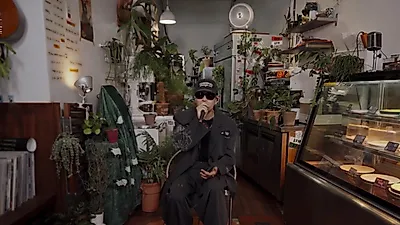
BOYNEXTDOOR's video for 'HOME: DELUXE,' titled 'Special Report: The Animals,' unfolds as a mock documentary centered on animal identities. Framed like a record of an unusual research project, the production establishes its subject through documentary-style captions, interviews and explanatory graphics.
The captions place the story at the fictional 'Modern Human Zoology Research Center' in Gyeonggi-do, South Korea. From there, the video introduces a supposed rise in the number of people who believe themselves to be animals other than humans, using that premise to set the tone for the investigation.
According to the explanation presented within the video, these people each identify with a different animal. They are portrayed as individuals who say the category of human alone cannot adequately explain who they are.
The research material builds a narrative in which the phenomenon was once considered rare but has grown until it resembles a broader social trend. Graphics attributed within the story to an overseas survey and a research institute claim that people in their teens and twenties account for 70% of the cases.
That statistic and the wider research scenario are presented as narrative devices inside the video rather than as external factual claims. The mock-documentary story then moves forward with Dr. Yoon Kyung-ho selecting nine participants for an experiment intended to uncover the true nature of the phenomenon.
The Nine Participants and Their Animal Identities
Kim Woon-hak appears as the first person to be interviewed and introduces himself as a pigeon. The video spends time piecing together his account of his family before connecting it to the premise that pigeons have strong reproductive capacity, turning the juxtaposition into a source of humor.
Lee Ri-woo is then labeled an owl. His segment depicts him as someone who remains awake at night and experiences problems with sleep, linking his behavior to the nocturnal animal assigned to him.
Kim Lee-han appears as a sloth and takes on the image of slow reactions and rest. The captions add that, because sloths have a low metabolic rate, resting serves as a survival strategy for the animal.
Myung Jae-hyun is introduced as an ant. He is portrayed as someone who began working after finding employment, followed a senior colleague around while learning the job, and then started talking about saving money and investing in stocks after receiving his first paycheck.
Kang Min-kyung is identified as a goldfish. After a quiet participant leaves, Jang Yo-hoon enters as a parrot, disrupting the atmosphere of the interview with repeated words and a loud voice.
Han Soo-woo is labeled a frog. Alongside his appearance, the video explains that animal calls are often vocalizations used for survival and communication rather than expressions driven primarily by emotion.
Commotion During the Music Experiment
Dr. Yoon Kyung-ho next attempts an experiment in which the participants listen to music and express whatever they feel. The task shifts the story away from individual interviews and brings the different animal identities together in a setting that becomes increasingly difficult to control.
In this sequence, Park Seong-ho appears as a penguin and is portrayed as an intensely curious participant. He fires off a stream of questions involving Antarctica, the Arctic, the desert, krill and pebbles, repeatedly redirecting attention through his curiosity.
As the group prepares to choose music, Jang Yo-hoon reacts by saying that he wants rock music. The surrounding noise continues to build, making it increasingly difficult for the laboratory to maintain control of the experiment.
Han Tae-san is shown as the first participant to leave his seat. The captions identify him as a llama and explain that llamas have a habit of checking things with their mouths and spit in order to maintain relationships within their herd.
Toward the end, the video offers the explanation that it is difficult to conclude that animals enjoy and appreciate music in a precise sense. That observation becomes the basis for the final question raised by the experiment.
If the participants are genuinely enjoying the music, the report suggests, they may be more complex beings than the experiment initially assumed. The story therefore avoids drawing a definitive boundary between the human and the nonhuman.
Instead of ending with a simple judgment about the participants, 'Special Report: The Animals' closes as a record of an effort to understand and empathize. Its mock-research framework ultimately leaves the identities at the center of the experiment open to consideration rather than reducing them to a fixed conclusion.
Related articles