
CALMSHOE Tests Plantar Pressure of Fourth-Generation ‘Noble Sneakers,’ Plans Production Improvements
CALMSHOE compared plantar pressure across three sneaker generations and will widen the fourth-generation model’s forefoot last for production.
Photo provided by CALMSHOE.
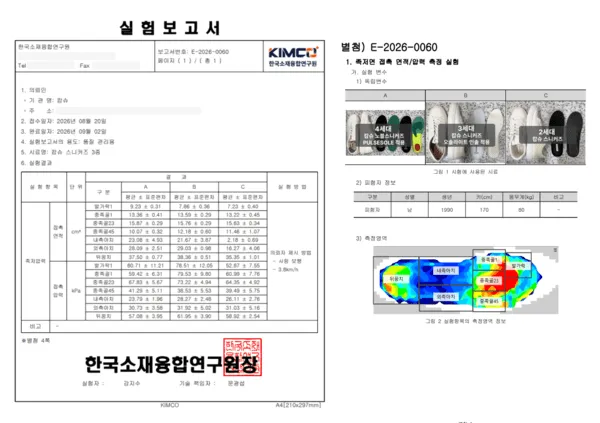
CALMSHOE has released test results comparing plantar pressure in its fourth-generation “Noble Sneakers” with that of earlier products. The fourth-generation model recorded lower contact pressure than the second generation at the medial arch and heel. At the fourth and fifth metatarsals, however, its pressure was the highest among the three products tested. CALMSHOE said it would incorporate the findings into the mass-production process.
On the 8th, CALMSHOE announced the results of comparative plantar-pressure measurements for its second-, third-, and fourth-generation sneakers. The company commissioned the Korea Materials Convergence Research Institute to conduct the test. Under the test conditions, an adult man walked at 3.8 kilometers per hour while the sole of the foot was divided into seven regions for repeated measurements of each product. The report number is E-2026-0060.
In the test, contact pressure at the medial arch measured 23.79 kPa in the fourth-generation Noble Sneakers, below the second-generation model’s 28.27 kPa. The fourth generation also produced a lower heel measurement: 57.08 kPa, compared with 61.95 kPa for the second generation. In post hoc analysis, the fourth-generation product was classified on its own as the lowest group among the three products at both locations, with statistical significance of p < .001.
The medial arch contact-area results showed a different pattern. The fourth-generation model measured 23.08 square centimeters, while the second generation measured 21.67 square centimeters. Post hoc analysis placed those two products in the same group, meaning that they were not statistically distinguishable on this measure. The third-generation model’s contact area was 2.18 square centimeters.
CALMSHOE explained that there was no significant difference in medial arch contact area between the fourth- and second-generation products, even though the two models differed in contact pressure at the same part of the foot. The pressure and area measurements therefore produced different comparative outcomes for that region.
By contrast, lateral arch contact pressure showed no statistically significant difference among the three products, with p = 0.199. At the fourth and fifth metatarsals, the fourth-generation model recorded 41.29 kPa, the highest value among the three products. CALMSHOE said it would examine whether this result could be related to the space inside the shoe.
In response to that finding, the company plans to widen the last—the shoe mold—around the forefoot and apply the change to the mass-produced product. CALMSHOE identified the amount of forefoot space as the specific area for improvement revealed by the test.
The Noble Sneakers feature “PULSESOLE,” a functional insole designed by CALMSHOE CEO Han Tae-san. Han studied physical therapy at Yonsei University and obtained a national physical therapist license. He founded CALMSHOE based on his clinical experience working with gait and weight support.
“In clinical practice, we think every day about how to support the foot, but no one actually measured what was happening inside the shoes patients wore when they left,” Han said. “CALMSHOE commissions an outside institution to conduct tests whenever the product generation changes because we want to keep the developer and the evaluator separate.”
Han added, “If we select and use only the items that produced good results, we cannot find what needs to be fixed. This test identified forefoot space as an area for improvement, and we plan to reflect that in mass production.”
CALMSHOE plans to commission an outside institution to measure the same items whenever the product advances to a new generation. The company also intends to disclose the results of those future measurements.



Comentarios 0