
Koo Chang-mo Reveals Why He Disappeared After the Success of 'Hinari' and Turned to Car Sales in Kazakhstan
Koo Chang-mo recalls the loneliness behind 'Hinari,' the 1990 PD scandal and the singing that led to a $340,000 car deal.
Singer Koo Chang-mo has shared the story of the isolation he experienced during his solo career and the unexpected path that transformed him into a businessman. In a recently released video on the YouTube channel “Dongchimi,” Koo spoke in detail about the psychological changes he underwent after his time with Songgolmae and the circumstances that ultimately led him to stop working as a singer.
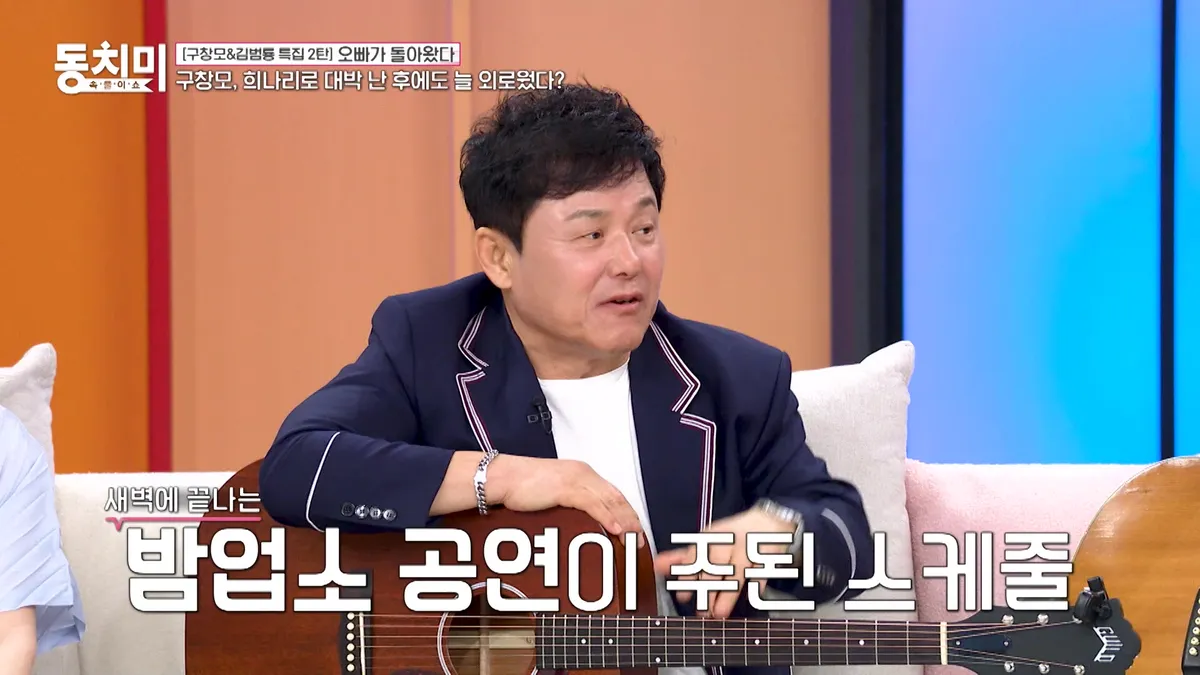
The Loneliness of a Solo Career Behind the Success of “Hinari”
Koo recalled that “Hinari,” a song released after his solo debut, became a major success. Yet the emotional reality he experienced during that period was far more complicated than the song’s popularity might have suggested.
According to Koo’s remarks in the video, he had lived and worked closely with the other members during his years with Songgolmae. After striking out on his own as a solo artist, however, the loneliness created by the absence of that shared life became the most difficult part of his new career.
He described finishing schedules that continued late into the night and feeling that he had nowhere to go afterward. On some nights, he would drive to Gyeongpodae, watch the sun rise and then turn around and head back. The memory illustrated the depth of the isolation he felt despite his success as a solo singer.
Koo also explained how “Hinari” came to be. He said it was the final song recorded for his solo album. Singer Na Hoon-a had told the head of Koo’s agency that there was a composer, Choo Se-ho, whose work would suit Koo well, and that recommendation led Koo to the song.
Koo added that although his relationship with Bae Cheol-ri had become somewhat distant at the time, Bae Cheol-soo continued to support and congratulate him on his success.
The Wounds of the 1990 PD Scandal and a Meeting at a Kazakhstan Music Festival
Explaining why his career as a singer came to an abrupt stop, Koo brought up the “PD scandal” that occurred in 1990. He said he was questioned by prosecutors as a witness and remained there for about 15 hours, an experience that left him deeply hurt.
The aftermath was severe. Koo said he went through such a difficult period that he threw aside his microphone and spent his days drinking. His relationship with singing had been damaged, and his life as a performer came to a halt.
A turning point arrived when he received an invitation to the “Voice of Asia” music festival in Kazakhstan. The unexpected opportunity took him away from the painful period that had followed the investigation and placed him on the path toward a completely different career.
Koo recalled both the fear he felt when he first arrived in Kazakhstan and the innocence he saw in the local people. At the festival, a chance encounter with a Korean man known as Chairman Min led to another fateful meeting, this time with Executive Director Kim Go-jung of Hyundai Corporation.
Kim was a fan of Koo’s music. Through Kim, Koo received a proposal involving the automobile business, opening the door to an occupation far removed from his previous life as a singer.
A $340,000 Automobile Contract Won Through Song
Koo described his transformation from singer to businessman as highly dramatic. In the beginning, he had no physical vehicles to show prospective customers. Carrying only catalogs, he went in search of buyers and struggled to persuade them to do business with him.
He eventually succeeded in securing a contract through singing. Recounting an encounter with a young bank president during a business trip to Moscow, Koo said he sang “Hinari” and “My Way” for the man at a hotel. His performance moved the prospective buyer in a way that the catalogs alone had not.
According to Koo, the bank president initially delayed the agreement but eventually asked him to sing “Hinari” once more. After hearing the song again, the man signed the contract and purchased 34 cars.
The deal was large enough to surprise Hyundai Corporation. Beginning with that contract, Koo continued selling automobiles in Central Asian markets, including Kazakhstan and Uzbekistan, and said the business ultimately generated substantial profits.
Comentarios 0